

Learned it? Cover the chart and see how many notes you can name.
Start Name the noteHow to read the chart
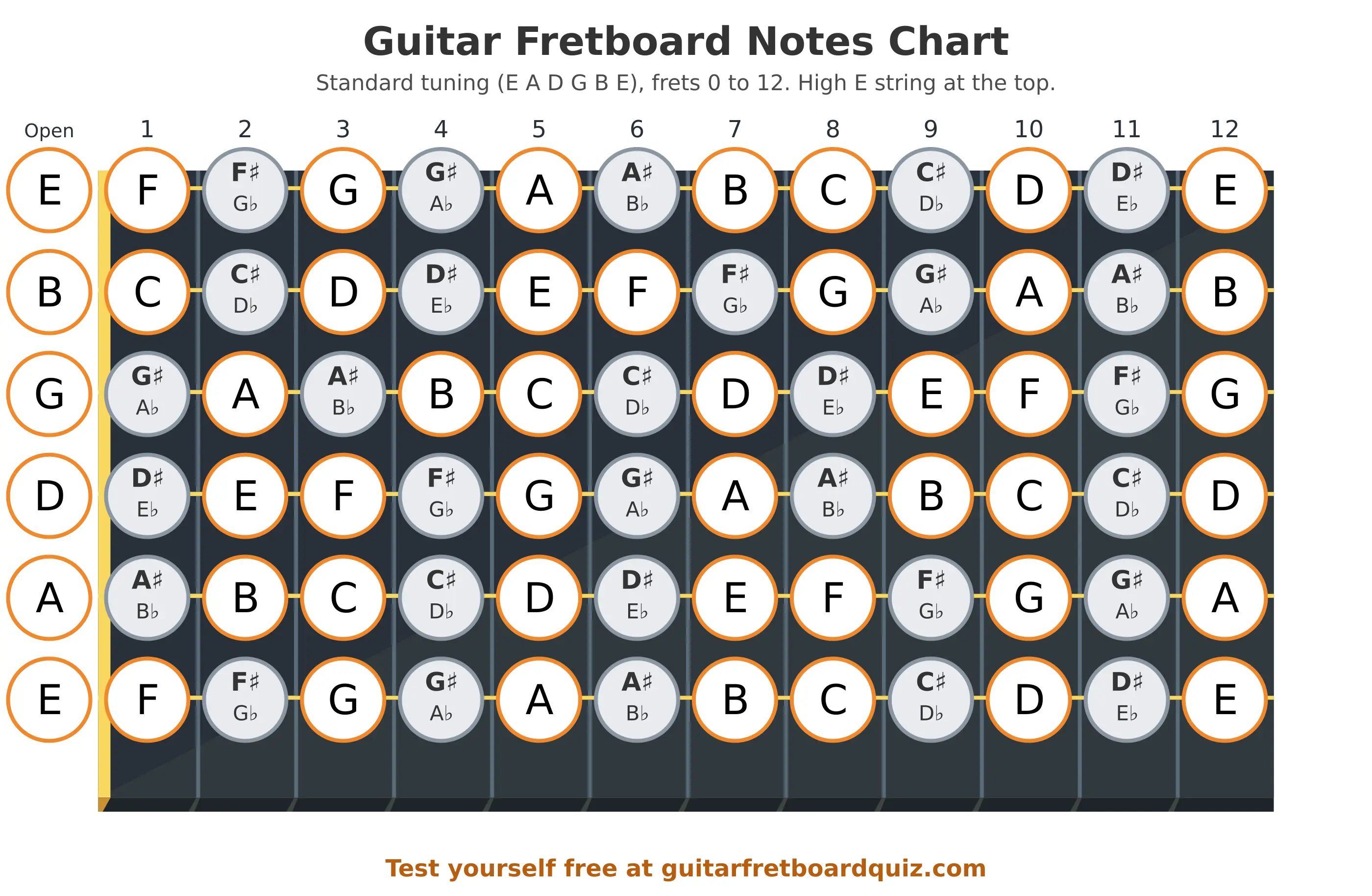
The chart shows a guitar in standard tuning as you see it in tab: the thin high E string along the top, the thick low E along the bottom, and the open strings in the column on the left. Each fret to the right raises the note by one half step. White circles are the seven natural notes, A to G. Grey circles are the notes in between, shown with both of their names, the sharp above the flat, because C♯ and D♭ are the same pitch.
The second chart leaves out the sharps and flats. With only the natural notes on the neck, the gaps are easier to see: every pair of naturals is two frets apart, except E to F and B to C, which sit side by side.
Patterns worth spotting
The 12th fret repeats the open strings one octave higher, so above the 12th fret the chart simply starts over. The two E strings carry exactly the same notes. And each string's 5th fret plays the open note of the next string up, apart from the G string, where the match is at the 4th fret. Those facts are why guitarists tune the way they do, and they let you check any note on the chart without counting.
Look down a single fret, too. At the 5th fret the six strings read A, D, G, C, E and A from low to high, and at the 7th they read B, E, A, D, F♯ and B. A few fixed columns like these become anchors you can count a fret or two from.
The DADGAD chart
DADGAD lowers three strings: the low E and the B drop a whole step to D and A, and the high E drops to D. The A, D and G strings keep their notes, so the middle of that chart matches standard tuning. With three strings on D and two on A, the chart has only three different rows: the three D strings carry the same notes fret for fret, so do the two A strings, and the G string is the odd one out. Strummed open, the strings sound a Dsus4 chord, the drone that makes DADGAD a favourite for Celtic and folk guitar.
From the chart to memory
A chart is the right place to start and the wrong place to stay. Looking a note up takes your eyes off the guitar, and the aim is to know each fret without checking. Print the chart and keep it on your music stand for a week, then cover it and test yourself with the free Name the Note quiz, which marks a fret and asks for its name. The results show exactly which notes you still reach for the chart to find.
Frequently asked questions
What are the notes on the guitar fretboard?
There are twelve: A, A♯/B♭, B, C, C♯/D♭, D, D♯/E♭, E, F, F♯/G♭, G and G♯/A♭. They repeat up each string, so the note at the 12th fret is the same as the open string, an octave higher.
Why do some notes on the chart have two names?
A note between two natural notes can be named from either side. The fret between C and D is C sharp, a half step above C, and also D flat, a half step below D. Which name is used depends on the key of the music.
Can I print the fretboard notes chart?
Yes. The free PDF has the full chart and the natural-notes chart in standard tuning and in DADGAD, on four A4 landscape pages, which also print on US Letter, in colour or black and white. You can save any of them as an image too.
Does the chart work for other tunings?
There are charts for standard tuning, E A D G B E from the thickest string, and for DADGAD. In drop D only the lowest string changes, and every note on it sits two frets further up the neck, so the standard chart still holds for the other five strings.